
How to Fuel for Your Marathon Part 1: Are you meeting your energy and recovery needs?
July 21, 2025
The Power of Resetting
August 6, 2025How to Fuel for Your Marathon Part 1: Are you meeting your energy and recovery needs?
July 21, 2025The Power of Resetting
August 6, 2025

Fueling For Your Marathon Part 2 – How To Fuel & Hydrate During Long Runs
Long runs are where you begin to build towards what race day will feel like. Your confidence grows, but mistakes in fueling and hydration may begin to reveal themselves. If you’ve ever felt great at mile 10 but hit a wall or even just noticed the extra bit of struggle by mile 14, you’re not alone. Long runs place unique demands on your energy system, hydration, and gut. Getting your fueling right here doesn’t just help the run feel better, it supports your ability to recover better and show up at your next session ready to go again.
This second article in our 4-part series will help you understand when to fuel during long runs, how to train your gut to tolerate mid-run carbohydrates, and how to avoid the most common mistakes we see marathon runners make during their training. There will be elements of this that are trial and error, but it’s the practice that makes you most confident for race day. Because the best race day plan is one your body already knows.
Why It Matters
Many runners wait until race week to figure out their nutrition. But long runs are where your fueling strategy is built, tested, and fine-tuned. Long runs (typically over 90 minutes) mark the point in training where nutrition starts to directly affect performance. If you’re not fueling well, you might:
- Start strong but hit a wall
- Recover poorly between sessions
- Increase your risk of GI symptoms or injury
- Limit your ability to hit race pace in later blocks
Fueling during long runs helps train your gut to handle carbohydrates and necessary fluid amounts during running as well as find which products work best for you. Training your gut can be as important as training your legs. Your gut, like your legs, adapts to training. Practising nutrition during long runs teaches your body to absorb and use fuel efficiently, even under stress.
Long Run Fueling Goals
At lower intensities, your body relies more on fat for fuel. But as pace, duration, and effort increase, carbohydrates become the primary energy source. This is because they’re more readily available and can be broken down faster than fat to meet the demands of harder running, when energy is needed immediately and consistently.
Once your long runs exceed 75-90 minutes, it’s time to start intra-run fueling, or adding in carbohydrates during your runs. Your glycogen stores, the stores where your body holds carbohydrates/energy, begin to deplete and run out after about 60-90 minutes of activity. So after an 80 minute run, you have depleted most, if not all, of your energy stores, similar to a car running out of fuel.
With depleted energy stores you may experience:
- Sudden energy drops
- Heavy legs
- Brain fog
- Nausea or dizziness
- Dehydration
- Hitting the wall mid-race
This is why you need to begin to add carbohydrates in during your run to prevent burnout. This can be challenging for some individuals to tolerate during exercise, but practice is key in training your gut to not only tolerate these carbohydrates but absorb them better.
Here are recommendations regarding intra-run fueling for long-runs:
- Follow the chart below to decide what your target carb intake during each run should be.
- Ideally split that quantity into small amounts every 30-40 minutes.
- Drink fluid with each gel or chew to aid absorption and prevent GI distress.
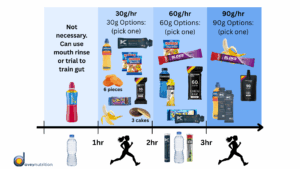
You don’t need to fuel every short or moderate run. But for runs longer than 90 minutes, or high intensity sessions, mid-run fuel helps protect your energy stores and prepares your body for race day conditions.
Remember to start small to begin training your gut if this is new to you. Trial fueling only on long-run days to give your system time to adjust. If you’ve already trained your gut a bit, now is the time to build consistency and test out the brands or formats (gels, chews, sports drinks) you plan to use on race day. Choose familiar products and test one thing at a time to see what works best for you and then stick to that product the remainder of your training.
Are You Running Hydrated?
Hydration is often overlooked in long-run nutrition, but it directly affects energy, endurance, and concentration. Even small drops in hydration status can lead to early fatigue, gut issues, and poor recovery.
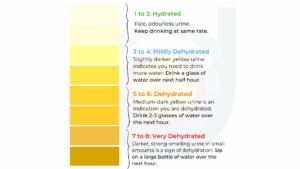
Monitor your urine colour to be able to see if you are hydrated day to day, aim for a pale yellow straw colour as shown below. If it’s darker than that, sip fluids consistently until it lightens. All fluids count, including tea, coffee, smoothies, milk, and juice.
How to Hydrate While You Run
Day to day, water should be sufficient to hydrate you. However, during longer runs you may be sweating out more than water can replace. When you sweat, you lose electrolytes, mainly sodium and chloride which are critical for performance, hydration, and fluid balance.
Without enough electrolytes, your body struggles to absorb and hold onto the water you’re drinking, leading to improper hydration even if you’re sipping regularly.
During long runs, in preparation for your marathon:
- Begin hydrating consistently to start training your gut
- You will need a substantial amount of liquid during your race, your gut needs to begin to get used to consuming this while running – practice makes perfect!
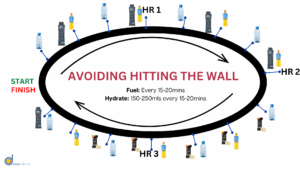
- Aim for 3-4 sips of fluid every 15 minutes
- This adds up to ~400-800ml per hour
- Your needs will vary depending on sweat rate, pace, and temperature
- For runs >90 minutes, you may need 300–600mg of sodium per hour
- This can come from electrolyte tablets, salt capsules, sports drinks, or salty snacks
This strategy will vary depending on the individual, but having a strategy is key. Find out what works best for you:
- How much volume of fluid should you consume at one time?
- How often should you take sips?
- Will you use a handheld bottle, vest, or belt?
- Where are the water stations located on the route?
Are You a Salty Sweater? You may need more sodium if:
- You get white streaks on your clothing after runs
- You have salt deposits on your skin when sweat dries
- Your sweat stings your eyes or tastes salty
If this sounds like you, aim toward the upper end of sodium intake (600mg/hour) and test options during long runs to see what your gut tolerates best.
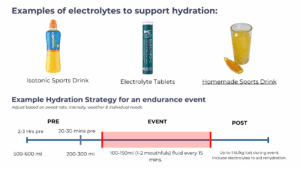
Consuming excessive amounts of plain water without adequate sodium can dilute the concentration of sodium in your blood, which can be dangerous. Balancing fluid and electrolyte intake is crucial.
Putting It Into Practice
If you’ve never fueled mid-run before, this is the week to start. Try it on your next long run, even if it feels early. Start small. Keep it simple. And track how you feel.
Pick one of these to try:
- Add one gel or chew at the 45-minute mark
- Try taking sips every 15 minutes during a run
- Test out an electrolyte product during your next run to see how you tolerate it
- Calculate out how many carbs you will need during your next marathon and find what source of carbohydrates could be use
What’s next?
Join our Marathon Fueling Webinar on August 18th at 7:30pm to learn more on long-run strategies and race day planning.
References
Burke, L. & Hawley, J. (2018). Swifter, higher, stronger: What’s on the menu? Science, 362, 781–787. https://doi.org/10.1126/science.aau2093
Tiller, N. et al. (2019). Nutritional considerations for ultra-marathon training and racing. JISSN, 16. https://doi.org/10.1186/s12970-019-0312-9
Bennett, J. & Kehoe, M. (2008). Marathon fueling techniques: A proposed intake schedule. Strength & Conditioning Journal, 30, 56–65. https://doi.org/10.1519/SSC.0B013E318187F1B5