
Your Best Was Enough: The Privilege of Play and the Purpose Behind Performance
October 28, 2025
Iron Status and Performance in Female Athletes
January 19, 2026Your Best Was Enough: The Privilege of Play and the Purpose Behind Performance
October 28, 2025Iron Status and Performance in Female Athletes
January 19, 2026
The start of a new year often brings a real sense of motivation, that feeling of wanting to drive on and that’s a great thing. Many people feel ready to reset, refocus, and invest in themselves, and that intent matters. Rather than dampening that energy, the goal is to work with it in a way that actually supports you long term. Supports your goals, your health, your performance and your everyday life.
Good, Better & Best
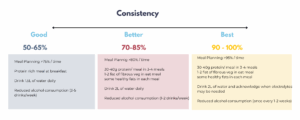
If you’ve worked with us 1:1 or joined one of our sessions, you might be familiar with our “Good, Better, Best” framework we come back to often. This approach is all about setting realistic, attainable, and sustainable expectations. Instead of aiming for perfection every day, which can be hard to maintain once life gets busy, we look at what good, better, and best can realistically look like across key areas such as mindset, sleep, nutrition, and movement.
A “best” day might be one where everything goes according to the calendar, training goes well, meals are balanced, hydration is on point, and mentally you feel content with all the boxes being ticked. A “better” day might be ticking a few of those boxes. A “good” day might simply be doing the basics that keep you moving forward. All of these still count. Progress isn’t built on perfect days alone, but on the accumulation of good and better ones.
If you’re not sure where to start, it can help to zoom in on the smallest changes you could implement right now. What’s one habit that would support you even on busy or unpredictable days? A large cross-sectional study of over 16,000 adults across 13 countries found that the majority of adults do not meet recommended daily fluid intake levels, with around 60% of men and 40% of women failing to reach adequate hydration targets (Ferreira-Pêgo et al., 2015).
Hydration is a simple example. Many people don’t drink enough water day to day, and even small increases can make a difference to how you feel. Research in healthy adults has shown that individuals who typically drink very little water report they experience less fatigue and less mental confusion when they increase their intake, while those who are used to higher intakes experience declines in mood, calmness, and positive emotions when their intake is lessened (Pross et al., 2014). The point isn’t that water is a magic fix, but that small, manageable habits can meaningfully influence how you feel, which in turn makes it easier to show up in other areas.
What this can look like in practice
Using hydration as an example, what’s realistic can look different depending on the day you’re having.
On non-training days, “good” might simply be starting the day with a glass of water and keeping a bottle nearby so you’re sipping regularly. “Better” could be being a bit more intentional with fluids around meals or meetings, and “best” might simply be being more aware of your hydration on days when you’re more active, stressed, or spending longer periods sitting.
On training days, hydration becomes more performance relevant. A “good” baseline might be ensuring you’re well hydrated going into a session. “Better” could be spreading fluid intake across the day and paying attention to how you feel during training. “Best” might be including a fluid that contains some carbohydrates before training, particularly ahead of longer or harder sessions.
What matters most isn’t hitting a perfect target every day, but understanding that hydration supports other habits, energy levels, focus, training quality, recovery, and even appetite regulation. When one small habit improves, it often makes the others easier to maintain too.
Learning a habit
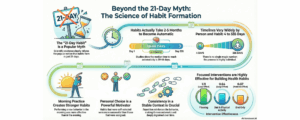
It’s also important not to expect yourself to introduce a new habit and execute it perfectly every single time. Missed days and weeks where things don’t always go to plan are part of the process. Habit formation takes time, and the research reflects that. A recent systematic review and meta-analysis examining health behaviour habit formation found that habits typically take around 59–66 days on average to become more automatic, with large individual variation ranging from a few days to many months (Singh et al., 2024). This challenges the common belief that habits form in just a few weeks and highlights why patience and consistency matter and we need to give ourselves some grace when forming these new habits.
This is also where habit stacking can be helpful. Habit stacking simply means attaching a new habit to something you already do automatically, rather than relying on motivation or memory. For example, drinking a glass of water when you make your morning coffee, or taking a few sips when you sit down at your desk. The habit is anchored to an existing routine, which gives it a clear cue and removes the need to “remember” or make a decision. Over time, that repetition in a familiar context helps the behaviour feel more automatic, even on the busy days.
Conclusion
The aim, especially at the start of the year, isn’t perfection. It’s consistency, sustainability, enjoyment and patience. Anchor small habits to routines you already have, allow for good and better days alongside best ones, and keep coming back to what’s realistic for you and your routine. Over time, those small, repeated actions add up, and that’s where meaningful, sustainable progress really comes from.
And while a lot of this comes down to what you do day to day, you don’t have to figure it all out on your own. Having the right support and accountability can make the difference between good intentions and habits that actually stick. If that’s something you’ve been missing, we’d love to help you build routines and practices around your nutrition that support your performance, not just in sport, but in life as well. Have a look at your next step here
References:
Ferreira-Pêgo, C., Guelinckx, I., Moreno, L.A., Kavouras, S.A., Gandy, J., Martinez, H., Bardosono, S., Abdollahi, M., Nasseri, E., Jarosz, A., Babio, N. and Salas-Salvadó, J. (2015). Total fluid intake and its determinants: cross-sectional surveys among adults in 13 countries worldwide. European Journal of Nutrition, 54(S2), pp.35–43. doi:https://doi.org/10.1007/s00394-015-0943-9.
Pross, N., Demazières, A., Girard, N., Barnouin, R., Metzger, D., Klein, A., Perrier, E., & Guelinckx, I. (2014). Effects of changes in water intake on mood of high and low drinkers. PLOS ONE, 9(4), e94754. https://doi.org/10.1371/journal.pone.0094754
Singh, B., Murphy, A., Maher, C., & Smith, A. E. (2024). Time to form a habit: A systematic review and meta-analysis of health behaviour habit formation and its determinants. Healthcare, 12(23), 2488. https://doi.org/10.3390/healthcare12232488